
-
- BoldMast EnanMast PropNandro DecaNandro PPPrimobolanSustanonTest CypTest EnanTest propTren AceateTren BlendTren ETren Hex
- AnadrolAnavarArimidexClenbuterolClomidDianabolProvironStanozololT3Tadalifil
Should we first practice maximum strength or muscle hypertrophy?
Views: 2 Author: Site Editor Publish Time: 2024-07-01 Origin: Site

Most people who go to the gym to exercise in the strength zone aim to gain strength and muscles. In order to achieve the best training effect, we generally need to follow some standard processes when conducting resistance training in the system. For example, the most traditional resistance process is: first perform muscle endurance training, then perform maximum strength and maximum output power training, that is, first increase muscle strength and then develop strength. But some people believe that classic strength training (such as the 5x5 training method) should be conducted to develop maximum strength, in order to lay the foundation for muscle growth. The debate between the two factions has a long history.
There are many studies showing that [1], while controlling the total load lifted, trainers can produce similar increases in strength and muscle mass (i.e., the training results are directly related to the training volume). For example, as mentioned in previous articles, using 80% 1RM and 60% 1RM for training with the same total training volume can produce similar muscle hypertrophy effects. However, from the perspective of developing strength, high-intensity training usually achieves better muscle strengthening effects. For example, 7 groups * 3RM have better strength improvement effects than 3 groups * 10RM [2], and 4 groups * 3-5 RM have better muscle hypertrophy effects than 3 groups * 9-11RM [3].
However, studies have shown that after training with high resistance training, deep squat jump training, and counter movement jump training, the 1RM limit of deep squats behind the neck of the subjects all achieved an equal increase [4]; Under the control of the total training amount, participants trained with different cycle training methods (i.e. linear training plan and nonlinear training plan) also achieved an equal increase in performance in push and leg flexion and extension [5].

So the question is, will different training arrangements (i.e. developing strength first and then developing muscle hypertrophy vs developing muscle hypertrophy first and then developing strength) bring consistent training results when the total training amount is consistent? In other words, is it better to increase muscle first or increase strength first? Which training sequence can bring better results in muscle and strength increase?
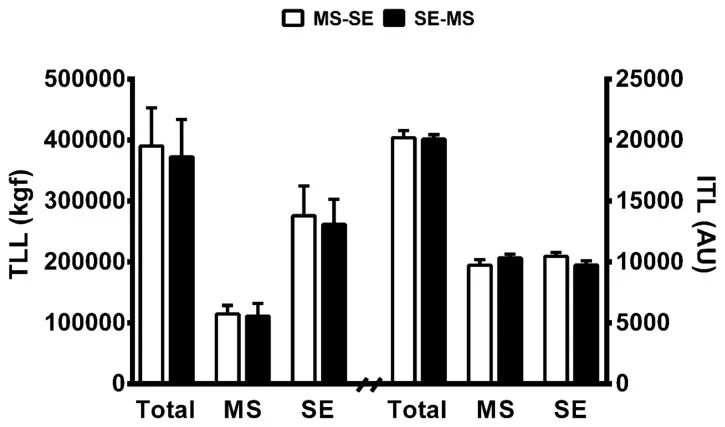
To investigate this issue, researchers conducted a study [6]: dividing the 12 week training cycle into two equal small cycles, with 6 weeks of maximum strength training and the other 6 weeks of muscle hypertrophy training. The training mode is also very clear. The maximum strength training adopts a 2-4RM intensity training method using compound movements, while muscle hypertrophy training uses compound movements+single joint movements, with a frequency range of 10-12RM. Researchers asked one group of participants to undergo 6 weeks of maximum strength training followed by 6 weeks of muscle hypertrophy training (referred to as the strength priority group), while another group of participants did the opposite: they underwent 6 weeks of muscle hypertrophy training followed by 6 weeks of maximum strength training (referred to as the muscle hypertrophy priority group).
The total training amount of the two groups of participants mentioned above is consistent. This can eliminate the interference of different training amounts on the experimental results. In addition, researchers also controlled the dietary conditions of the participants and excluded differences in nutrition.
The results after 12 weeks showed no significant difference between the strength priority group and the muscle hypertrophy priority group in terms of maximum explosive power and muscle thickness. It is worth mentioning that although the muscle hypertrophy priority group had a slightly better muscle gain effect than the strength priority group in absolute values, there was no significant difference between groups in all research indicators after 12 weeks.
Wait, is this result slightly different from some of the viewpoints we have seen before. Because the traditional view has a fundamental assumption that the development of strength training must start from the stage of muscle hypertrophy and then transition to the increase of maximum strength, and this development process is linear (that is, an increase in muscle mass must be accompanied by an increase in strength). But as we continue to deepen our understanding of human development, we will find that there are various training methods and techniques to achieve the same training results, known as "all roads lead to Rome". There are also many training plans that can focus on developing other qualities while also maximizing muscle hypertrophy, increasing explosive power and maximum speed, and so on.
So now we can answer the question raised at the beginning: both strength priority and muscle hypertrophy priority are good, and under controlled conditions, different training plans can achieve the same good results on a certain indicator. This reminds us that there is not only one training method in the world, because people have multiple physical qualities, and the connections between these physical qualities will affect each other and improve each other during the training process (this is actually not contradictory to the thinking of specialized training). We should try different training ideas and choose the training that can best help ourselves develop according to our own physical characteristics, so as to gain more training experiences.
reference material:
1、 Angleri V, Ugrinowitsch C, Libardi CA. Crescent pyramid and drop-set systems do not promote greater strength gains, muscle hypertrophy, and changes on muscle architecture compared with traditional resistance training in well-trained men. Eur J Appl Physiol. 2017;117(2):359–369.
2、Campos GER, Luecke TJ, Wendeln HK, Toma K, Hagerman FC, Murray TF, et al. Muscular adaptations in response to three different resistance-training regimens: Specificity of repetition maximum training zones. Eur J Appl Physiol. 2002;88(1–2):50–60.
3、Schoenfeld BJ, Ratamess NA, Peterson MD, Contreras B, Sonmez GT, Alvar BA. Effects of different volume-equated resistance training loading strategies on muscular adaptations in well-trained men. J Strength Cond Res. 2014;28(10):2909–2918.
4、Loturco I, Ugrinowitsch C, Roschel H, Lopes Mellinger A, Gomes F, Tricoli V, et al. Distinct temporal organizations of the strength- and power-training loads produce similar performance improvements. J Strength Cond Res. 2013;27(1):188–194.
5、Prestes J, Lima C, De Frollini AB, Donatto FF, Conte M. Comparison of linear and reverse linear periodization effects on maximal strength and body composition. J Strength Cond Res. 2009;23(1):266–274
6、Order of Resistance Training Cycles to Develop Strength and Muscle Thickness in Resistance-Trained Men: A Pilot Study,JÚLIO BENVENUTTI BUENO DE CAMARGO et al.


